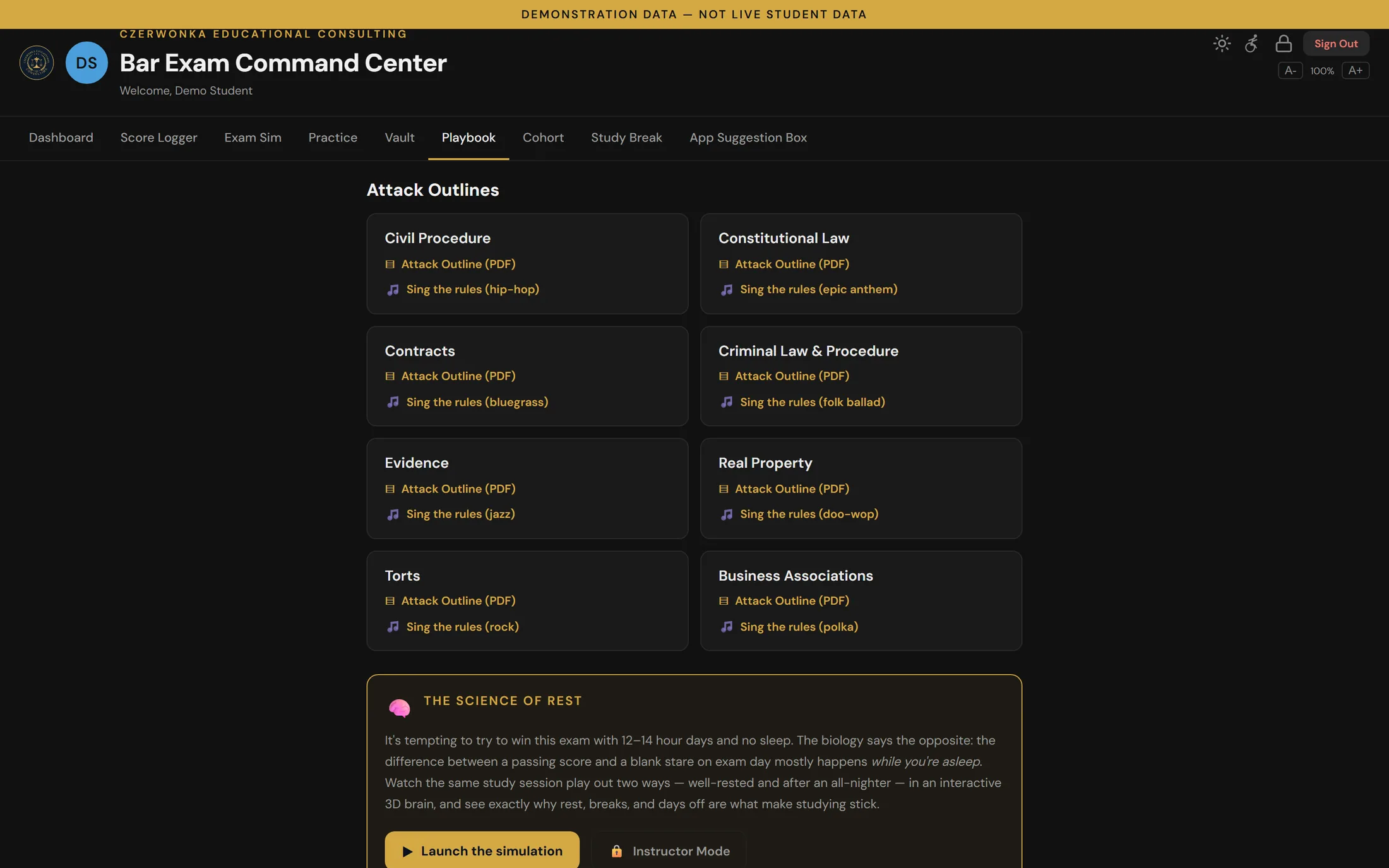
Where you actually stand
Your jurisdiction's cut score, your countdown, and your practice history in one place. Set the target, and everything downstream — scaling, the predictor, the pass estimate — recalibrates to that jurisdiction.
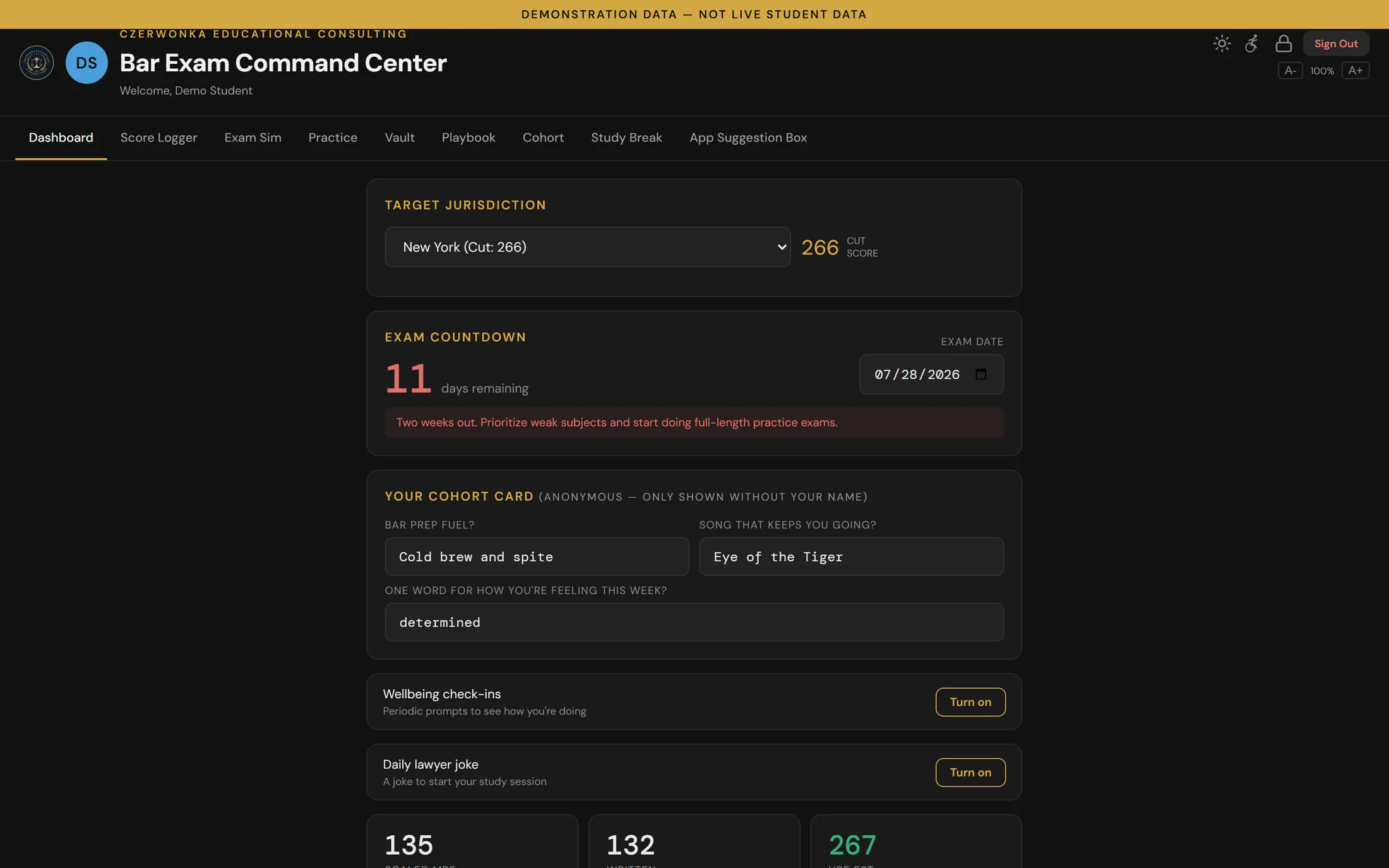
A predictor that doesn't flatter you
Your logged MBE accuracy and essay scores become a scaled estimate against your jurisdiction's cut — weighting recent work more heavily, because what you knew five weeks ago matters less than what you know now. It reports a confidence band rather than a single number, because a point estimate on its own would overstate what the data can support. Sometimes the honest answer is “possible.”
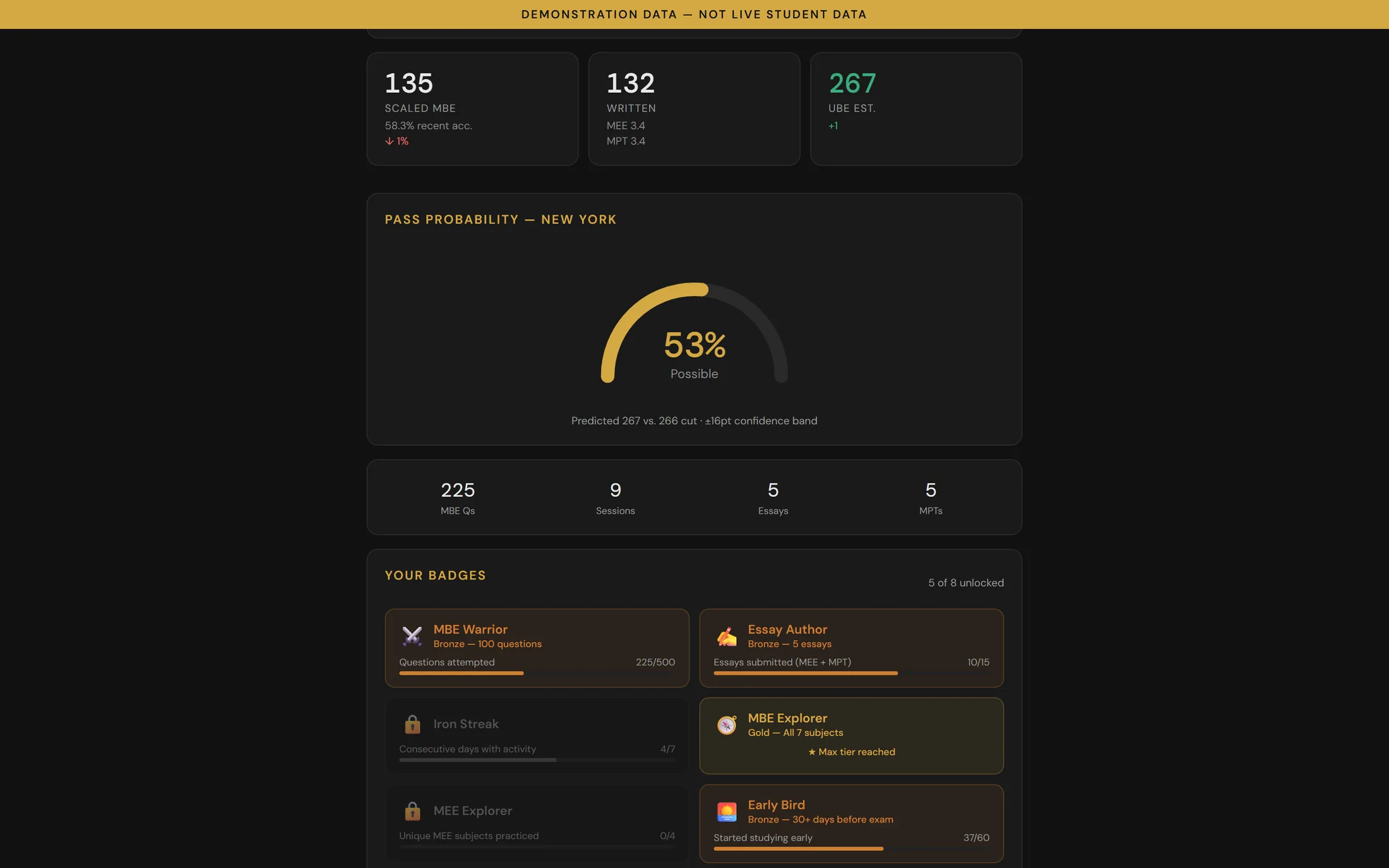
Three ways to practice
Adaptive multiple-choice that adjusts to your ability in real time and feeds straight into your score tracker. Original essay prompts with feedback scored on the 1–6 NCBE scale. An AI-drafted response comes back to you instantly, flagged as preliminary, so you are never sitting idle waiting on me — and then I review every single one before it stands as final. Not a sample of them. Every one, guaranteed. Instructor challenges are assigned and reviewed personally.
NextGen, built in
If your jurisdiction gives the NextGen exam, your account is set to it and a NextGen Prep track opens: standalone questions in the new formats, including select-two items, browsable by subject or by NCBE’s NextGen outline; integrated question sets that ask you to counsel a client or draft the document; and full-length performance tasks. Written work on the sets and tasks is scored against a rubric. Not sure when your jurisdiction switches? The platform shows each jurisdiction’s first NextGen administration and announced passing score — confirm yours with your board.
Immersives: practice doing the work
NextGen tests what a lawyer does with the law, not only whether you can recite it. The immersives are where you practice that. In Sustained, a trial runs in front of you and you object in real time — the rules of evidence applied at the speed of a courtroom, not at the pace of a flashcard. The Trial is a cinematic Evidence and Criminal Procedure case: you weigh what comes in and make the calls as it unfolds, untimed, with the reasoning laid out after each one.
Three more are in beta, and open now to students preparing for NextGen: Consideration, a transactional simulation with graded drafting; Guiding Principles, a serial that has you apply estates rules to the documents in front of you — the way NextGen tests that subject; and Argued and Submitted, an appellate argument that starts, as NextGen’s document-based questions do, with reading the record. Students sitting the current UBE get them when they leave beta.
I use AI grading on best-in-class models I have personally calibrated to the task, because it gives you immediate, preliminary feedback on your performance while you wait for me to grade it. Certain simulation activities also run deterministically on AI.
You may always opt out of submitting your essays and other work product to AI grading, and I will happily grade everything by hand — but bear in mind that certain features, like the real-time courtroom objection simulator, depend on AI to make them work. Hand grading costs you nothing, consumes none of your hours, and stays available after your package is exhausted. The 72-hour turnaround still applies: that clock always measured my grading, not the AI’s. It covers every piece of written work, not only mocks, and it runs from the timestamp on your submission — so if the AI draft is late, or never arrives at all, the clock has been running the whole time regardless. I also cap each cohort at twenty students, fewer if committed hours require it, because a promise to read everything myself is only worth having at a size where I can keep it.
There is no partial refund for opting out: the platform is priced as a whole, and the $500 the agreement allocates to it is a notional figure for the liability cap and the renewal credit, not a fee that can be handed back piece by piece. I stand firm because I stand behind my product, and want you to know the implications of that choice. Giving you the option, having you exercise it, and handing you the “skim milk” product by surprise is not my style.
On the ethics of using it at all. In June 2026 I completed Ethics of AI at the London School of Economics and Political Science — a three-week online course on algorithmic bias, fairness, transparency, and where automated systems should and shouldn’t be trusted with decisions about people. Verify the certificate — certificate 0561389, issued 20 July 2026; the verification confirms the issuer and that I am the holder, not merely that a certificate exists. It is a short course and I am not going to dress it up as more than that. I took it because I was already putting AI between a student and their bar results, and I wanted the objections argued at me by people who study this rather than worked out alone on my own time.
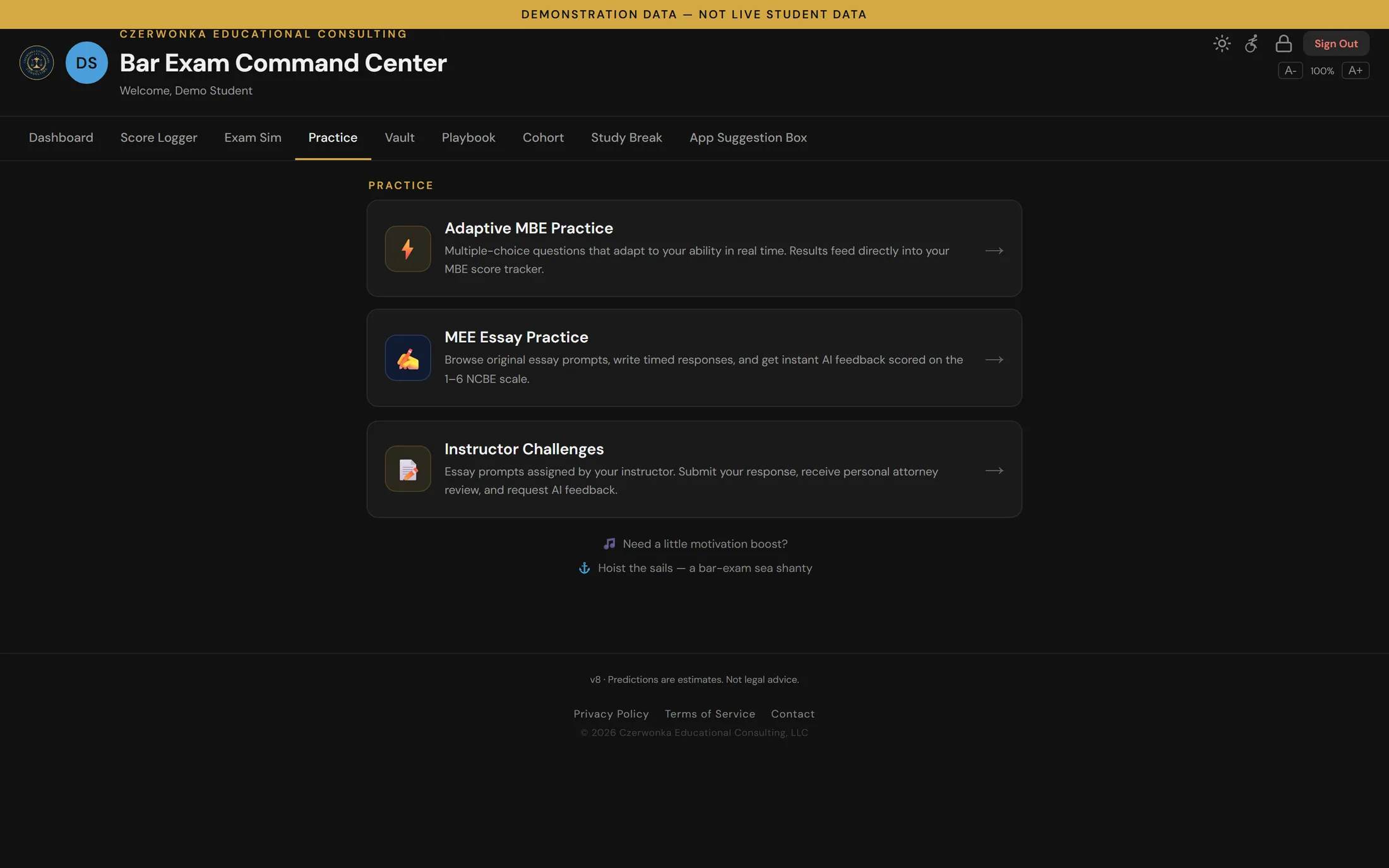
Attack outlines — and the rules set to music
An attack outline for every MBE subject plus Business Associations. And because retention is the whole game, the black-letter rules are also recorded as songs — eight subjects, eight genres, from bluegrass to polka. The Science of Rest simulation is in here too: an interactive 3D model of what sleep does to what you studied.